Kinetic Impedance & The Marine Entropy Crisis
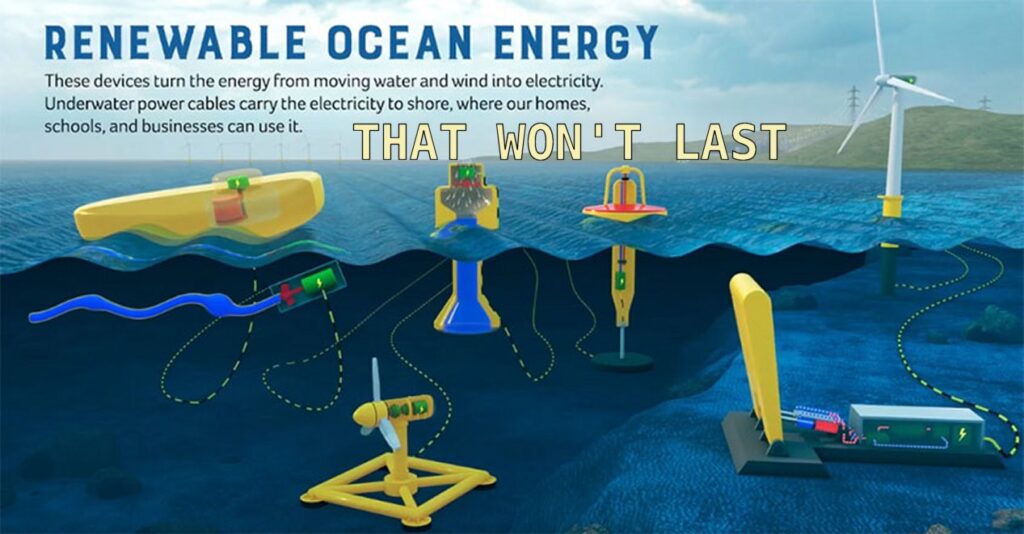
The global push for “Ocean Wave Energy” has been marketed as a boundless resource. However, from a fluid dynamics and materials science perspective, these systems represent one of the most significant engineering miscalculations of the 21st century.
The “Why”: The Physics of Failure
The fundamental flaw in Wave Energy Converters (WECs) is Mechanical Impedance. To capture energy from a wave, a machine must “resist” the ocean’s force. This creates a binary of failure:
The Fatigue Limit: The constant 24/7 oscillation leads to structural fatigue (reaching $10^8$ cycles in record time), causing catastrophic joint and weld failures.
The Survivability Paradox: If you build a machine heavy enough to survive a “100-year storm,” it is too heavy to move and generate electricity during the 95% of the time the sea is calm.
The “What”: The Three Pillars of Deception
Biofouling & Drag: Within weeks of deployment, marine organisms (barnacles, algae) attach to moving parts. This increases the mass of the device by up to 20%, destroying the tuned resonance required for energy capture.
Corrosive Electrolysis: The ocean is a giant battery. Submerging diverse metals leads to accelerated galvanic corrosion. No “Green” coating has yet survived the combined assault of salt, sand abrasion, and UV exposure.
Acoustic Deserts: Much like the wind turbines discussed in our Dangers of Wind Turbines audit, WECs create high-decibel “clanking” and hydraulic noise that disrupts the sonar of cetaceans, creating biological dead zones.
The “When” and “Where”: A History of Lost Capital
Since the early 2000s, dozens of “Greenie” wave projects in the North Sea, the Pacific Northwest, and Australia have reached the same conclusion: The maintenance cost exceeds the energy value.
The Maintenance Debt: Servicing a broken hinge or a leaked hydraulic seal 5 miles offshore in 15-foot swells is not just dangerous—it is economically impossible.
The Grid Reality: By the time the erratic, low-frequency power of a wave is “cleaned” and converted to high-voltage AC, the Energy Return on Investment (EROI) is often near zero.
The Theron Correction: Shifting the Paradigm
While the world has been sold a “bill of fake constructs,” Theron Transform realizes that the ocean is meant to be a habitat, not a machine shop.
Instead of fighting the tide: We use Permanent Magnetic Generators that are shielded from the elements.
Instead of external “swings”: We utilize internal magnetic flux oscillation.
The Result: We provide the “Perpetual” energy the ocean promises, without the environmental bombshells of $SF_6$, sonar disruption, or microplastic shedding.

Technical Proof: The Engineering Graveyard
The “Green” narrative often hides the multi-million dollar failures of wave energy under the guise of “prototyping.” However, the data from these projects confirms the Survivability Paradox and Mechanical Impedance issues identified by Theron Transform.
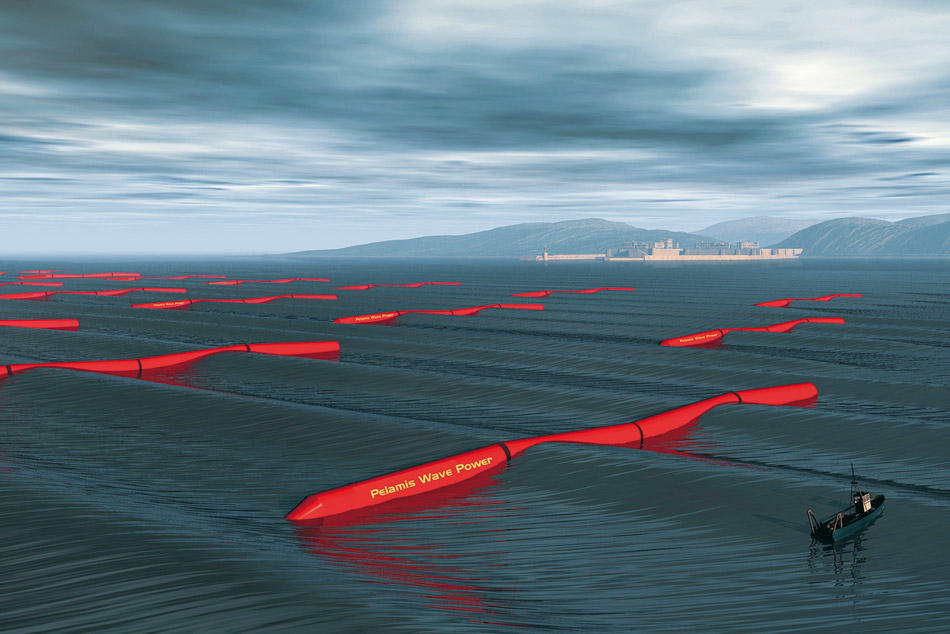
1. The Pelamis “Sea Snake” (Portugal/Scotland)
The Investment: Over $100 Million in venture capital and government grants.
The Failure: Billed as the world’s first commercial wave farm, the joints—designed to resist the ocean’s force—suffered from catastrophic fatigue and seal failure.
The Outcome: The company went into administration in 2014. The “snakes” were sold for scrap, proving that hinged resistance cannot survive the 24/7 kinetic assault of the Atlantic.
2. The Azura Project (Hawaii)
The Data: Monitored by the Navy and the DOW, this “point absorber” was meant to prove long-term viability.
The Failure: Despite being a “success” in short-term bursts, the maintenance-to-output ratio was unsustainable. The cost of deploying divers and specialized vessels to fix submerged mechanical pivots exceeded the value of the erratic electricity produced.
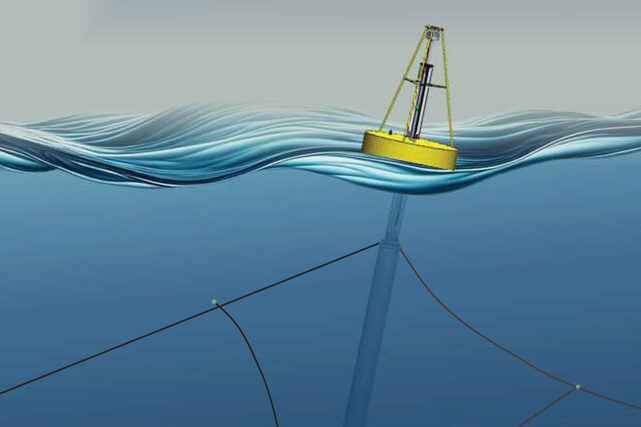
3. The WaveSwinger (various global tests)
The Failure: These submerged “pressure” systems frequently succumb to Biofouling. Within months, the weight of barnacles and the friction of algae growth reduced the mechanical efficiency to the point where the device could no longer reach resonance with the waves.
Comparative Engineering Audit: Wave vs. Theron
| Metric | Wave Energy Converters (WECs) | Theron Magnetic Generator |
| Serviceable Life | < 5 Years (due to fatigue) | 25 – 100 Years |
| Mechanical Impedance | High (Must fight the water) | Zero (Internal magnetic flux) |
| Maintenance Access | Dangerous/Offshore (Vessel required) | Direct Access (Surface or Sub-surface) |
| Biological Impact | Acoustic Masking & Clanking | Acoustic-Zero (No external noise) |
The Final Word on “Marine Entropy”
As an engineer with multiple degrees, I know that Entropy always wins in the ocean. The salt, the pressure, and the kinetic chaos are designed to tear machines apart. Theron Transform succeeds because we don’t put our mechanics in the line of fire. We harness the perpetual swing of the magnetic pendulum from a position of shielded strength.